
There are two kinds of men who shape Texas.
The first kind draws lines on paper so straight they might as well have been pulled tight with barbed wire between two mesquite trees. The second kind takes those lines and wrestles them into existence with steel, sweat, and a vocabulary not fit for church but perfectly suited for progress.
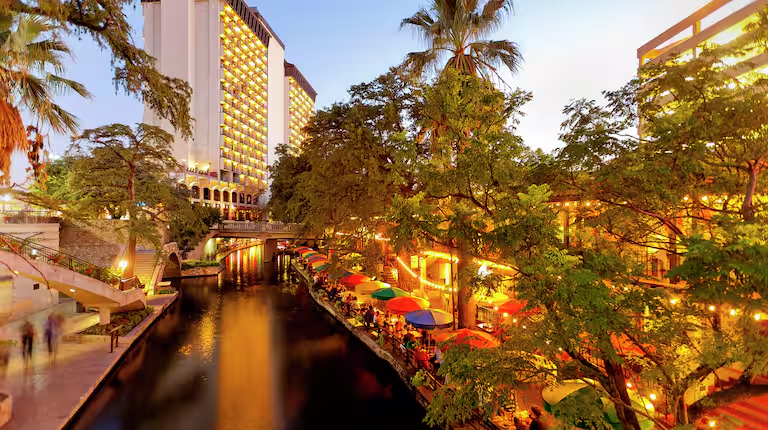
In 1968, in San Antonio, those two kinds of men met somewhere between the ground and the sky, dangling from a crane hook with a fully furnished hotel room swaying like a chandelier over the San Antonio River.
One of them was a legend.
The other one less known.
H.B. Zachry was not the sort of man who needed to raise his voice.
He had built his reputation the way West Texas builds character, slowly at first, then all at once. Born in 1901, Texas A&M in ’22, engineer by trade, empire builder by necessity. He started his company in 1924, back when a handshake still counted and a man’s word could be mortgaged against the future.
By the time most folks were trying to figure out how to keep their fences from leaning, Zachry was building dams that held back rivers, pipelines that crossed continents, and structures in places where maps still had blank spots labeled “good luck.”
He had that particular Texas calm about him, the kind that made impossible things sound like minor scheduling inconveniences.
When he told Hilton he could build a 21-story hotel in under nine months, he didn’t blink.
When he added that if he didn’t, he’d do it for free, he didn’t smile either.
That was just business.
T.C. Tomball, on the other hand, smiled all the time.
Not because life had been easy, but because he found it funny that it hadn’t managed to beat him yet.
Born and raised in Fort Stockton, educated at Our Lady of Immeasurable Concern, Class of ’56, top 20% if you asked the school, top 5% if you asked T.C. himself. He had the kind of mechanical intuition that made other men suspicious.
Put a wrench in his hand and a problem in front of him, and he’d solve it with the same ease most folks used to butter toast.
He could run a bulldozer like it was an extension of his spine. He could feather a crane control with the delicacy of a man threading a needle in a windstorm. He could look at a pile of steel and see not what it was, but what it wanted to become.
San Antonio was supposed to be temporary.
That was the story, anyway.
The Hilton Palacio del Rio wasn’t supposed to exist.
Not like this.


HemisFair ’68 was coming, and San Antonio needed a hotel that didn’t just house guests, but impressed them, dazzled them, made them believe Texas had one boot planted in tradition and the other kicking open the door to the future.
Traditional construction wouldn’t make the deadline. Not even close.
So Zachry did what men like him always did when reality got in the way.
He changed reality.
Four floors would go up the old-fashioned way. The core would rise using slip-form construction. And the rooms, the hundreds of rooms, would be built somewhere else entirely, fully finished, furnished, wired, plumbed, decorated down to the ashtrays, then trucked in and stacked like a child’s set of building blocks.
Like Legos, if Legos weighed several tons and came with indoor plumbing.
Most folks thought it was madness.
T.C. Tomball thought it sounded like Tuesday.
Zachry found him the way men like Zachry always found men like T.C.
He watched.
Not in an obvious way. No clipboard. No questions. Just a quiet observation of who solved problems and who created them.
T.C. didn’t just solve problems. He made them feel embarrassed for showing up in the first place.
A crane operator missed his mark by six inches, and T.C. adjusted the load mid-air like he was guiding a grocery cart into a tight parking space.
A foreman said something couldn’t be done, and T.C. did it while the sentence was still hanging in the air.
So Zachry called him in.
Didn’t offer him the job right away. Just talked.
About the project. About time. About risk.
About what it meant to promise something out loud in Texas, where folks had long memories and longer opinions.
Then he made two promises.
The first was to Hilton.
The second was to T.C.
“Finish this job on time,” he said, “and I’ll see to it you’re driving something better than a pickup.”
T.C. leaned back in his chair, boots crossed at the ankle.
“What kind of something?” he asked.
Zachry allowed himself the smallest hint of a smile.
“A Lincoln.”
The car arrived before the building was finished.
That was intentional.

It sat just off-site some mornings, black as a preacher’s suit and twice as serious, catching the early sun in long, quiet reflections. Word spread through the crews faster than bad coffee.
Tuxedo Black, straight from Wixom, Michigan.
Quadruple headlights that looked like they were studying you.
Chrome bright enough to make a man check his own reflection.
Rear doors that opened backward, like the car was inviting you in rather than letting you out.
Inside, it was all tufted black leather and woodgrain trim, the kind of place where even a loud thought felt out of place. Bench seats front and back. Power everything. Air conditioning that didn’t argue. A radio with buttons that clicked like decisions.
Under the hood, a 460 cubic inch V8 with a four-barrel carburetor, enough torque to move a small piece of geography if you asked politely.
Three-speed C6 automatic. Smooth. Confident. No wasted motion.
It wasn’t just a car.
It was a statement.
And for T.C. Tomball, it was a finish line you could park in.
The job itself didn’t care about any of that.
The job cared about time.
Crews worked around the clock. Days bled into nights and back again. The modular units came in like a steady parade of possibility, each one complete down to the last detail.

Beds made.
Lights wired.
Paint dry.
Ashtrays in place, waiting patiently for bad decisions.
T.C. orchestrated it all from a crane cab that might as well have been a throne. Up there, he wasn’t just moving steel. He was conducting a symphony of weight and motion, every lift a note, every placement a measure.
Forty-six days.
That’s how long it took to place every room.

Forty-six days to do something that had never been done at that scale, in that way, under that kind of pressure.
Most men would have called it impossible.
T.C. called it efficient.
April crept closer.
HemisFair didn’t care about excuses. It had a date, and that date was coming whether the hotel was ready or not.
But the hotel was ready.
More than ready.
Five days early.
Which, in Texas, is the difference between a miracle and a story folks tell for the next fifty years.
The last room was Room 522.
Top of the building. Twenty-one stories up. The final piece in a puzzle that had no business fitting together this well.
It sat on a flatbed eight miles from where it would spend the rest of its life, fully furnished, fully dressed, like it had somewhere to be.
Zachry arrived that morning not in a rush, but in that measured way of his, like he had already accounted for the outcome.
And behind him, rolling in with the quiet authority of a bank vault on wheels, came the Lincoln.
T.C. noticed it without looking.
You don’t miss something like that.
They stepped into the room together.
H.B. Zachry and his wife Molly.
Room 522, not yet a room, still just an idea with walls.
T.C. stood at the controls, one hand resting on the levers like a pianist about to begin.
Zachry walked out onto the balcony, looked down, and found T.C. with his eyes.

Didn’t say a word.
Just gave a thumbs-up.
That was enough.
The crane took the weight.
Slow at first, like it was thinking about it.
Then steady.
Up.
Twenty-one stories of air between where it was and where it belonged.
The room rose like a promise being kept.
Men on the ground stopped what they were doing. Conversations paused mid-sentence. Even the river seemed to take a breath.
Up there, suspended between earth and sky, sat a fully furnished hotel room with a husband and wife standing on the balcony like they’d already checked in.
If Houston was busy figuring out how to send men to the moon, San Antonio was busy figuring out how to send a bedroom to the twenty-first floor without spilling the lamp.
Different problems.
Same kind of people.
T.C. worked the controls with the kind of focus that makes time irrelevant.
No wasted movement. No hesitation.
The room swung once, just a little, caught a breeze like a thought trying to wander, and then settled.
Guided.
Lowered.
Placed.
Perfect.
Like it had always been there.
Twelve minutes later, they were back on the ground.
Zachry and Molly stepped out, composed, smiling, like they had just returned from a short elevator ride rather than a small act of defiance against gravity.
Cameras flashed.
Hands were shaken.
Autographs signed.
History, for a brief moment, behaved itself.
Then Zachry reached into his pocket.
Pulled out a set of keys.
And tossed them.
Not ceremoniously. Not with a speech.
Just a clean, easy throw.
T.C. caught them the way he caught everything else.
Without making a fuss.
The Lincoln idled nearby, patient.
T.C. walked over, opened one of those rear-hinged doors, and stood there for a second longer than necessary.
Not because he was surprised.
But because he understood what it meant.
This wasn’t just a reward.
This was recognition.
From one kind of man to another.
Zachry left in a limousine.
That was fitting.
Men like him were always on to the next thing.
Another project. Another impossibility waiting to be downgraded to a scheduling detail.
T.C. stayed.
He slid behind the wheel, hands settling onto the wood-trimmed steering wheel like they belonged there.
The seat adjusted with a quiet hum.
The engine turned over with the confidence of something that knew exactly what it was built to do.
He didn’t rev it.
Didn’t show off.
Just eased it into gear.
San Antonio looked different from behind that wheel.
Or maybe he did.
Hard to say.
The hotel stood behind him, twenty-one stories of proof that sometimes the craziest idea in the room is just the one that hasn’t been done yet.
Back in Houston, men in white shirts and thin ties were strapping themselves into rockets, aiming for the moon in machines that burned fuel like it had a personal vendetta.
They got Corvettes.
Fast. Flashy. Built for speed and headlines.
Out here, a crane operator got a Lincoln.
Heavy. Quiet. Built for presence.
Both of them, in their own way, were riding the edge of what was possible.
T.C. drove north for a while.
Not home yet. Not Fort Stockton. Not even sure he’d ever go back for good.
Some places stay with you whether you stay with them or not.
He rolled down the window, let the Texas air come in, dry and familiar.
The kind of air that reminds you where you came from, even when you’re headed somewhere else.
Years later, folks would talk about that hotel.
About how it went up faster than anything had a right to.
About the rooms that flew.
About the man who promised the impossible and delivered it five days early.
They’d use words like innovation.
Engineering.
Vision.
But every now and then, if you caught the right old-timer on the right day, maybe sitting at a counter with a cup of coffee gone cold, you’d hear a different version.
They’d lean in a little.
Lower their voice just enough to make it feel like something worth hearing.
And they’d say it wasn’t just about the man who made the promise.
It was about the man who made it happen.
The one up in the crane.
The one who took a finished room, a couple standing on a balcony, and a whole lot of expectation…
…and set it down exactly where it belonged.
Because in Texas, building something big isn’t about making noise.
It’s about making it look easy.
And on that day in 1968, somewhere between a river and the sky, two men did exactly that.
One with a promise.
The other with a pair of steady hands.
And parked nearby, gleaming like a quiet exclamation point, sat a Tuxedo Black 1968 Lincoln Continental.
Proof that sometimes, when you do the impossible like it’s no big deal…
Texas notices.
Even if it doesn’t say so out loud.


3 responses to “LEGOS AND LINCOLNS”
T.C. at work.
https://m.youtube.com/watch?v=2t3-PeLcIYg
Awesome, Cap.
This is the second time this month I’ve heard this story. The first guy failed to mention the Lincoln. But he was drivin’ a boat. Wadded he know? As with all The Captain’s stories, I like this one better.
Benard Marx