
The first time the old Dodge showed up, Rusty Hammer thought somebody was playing a joke too expensive for Fort Stockton.
It was parked crooked in front of Rusty Hammer Hardware just after sunup on a Tuesday, black body dull as stove soot, white roof and front doors looking like they had long since given up on cleanliness and chosen memory instead. It sat there with both spotlights catching the early light, one red on the driver’s side and one clear on the passenger side, like a pair of tired eyes that had once known exactly who to stop and who to wave on through.
Nobody had seen it pull in.
That was the part folks kept circling back to.
Fort Stockton was not a place where an unfamiliar car could materialize unnoticed. A strange dog could not cross Dickinson Boulevard without getting a nickname and a ham sandwich. Yet there it was, a 1963 Dodge 880 police sedan, broad-shouldered and heavy-browed, looking like California had coughed up one of its old sins and spat it onto the courthouse square.
Rusty stood on the sidewalk with his coffee cooling in his hand and said, “Well, I’ll be damned. Christine’s uglier cousin finally made parole.”

Rex Hall, who had walked over from the drug store for the precise purpose of seeing what the fuss was about, adjusted his glasses and frowned at the car as though it had failed a prescription refill.
“That wasn’t Christine,” he said. “Christine was a Plymouth, and she was one of the bad guys. This thing was driven by the good guys.”
Rusty looked at him. “You say that like California ever sorted out which was which.”
By eight-thirty, half the square had come to stare at it.
Lucinda came over from Grounds for Divorce wiping her hands on a towel, Delgado peering from the diner doorway behind her like a man already tired of whatever this day planned to become. Chad from the Piggly Wiggly stood with his arms crossed and his expression set to “insurance concern.” Sister Thelma arrived last, not hurried but exactly on time for the start of nonsense. She studied the Dodge the way some women studied tea leaves and others studied unpaid utility bills.
The car had the look of something that had not merely aged but endured. The black paint was worn through in places, the roof rusty, the hood freckled orange-brown, and there were patches on the body where the years had gnawed right through dignity. The rocker panels were rough. The fenders were blistered. The rear doors, somebody discovered when they tried them, were stuck shut like the car had sworn an oath not to let anything out that had once gotten in.
On the front bench, visible through the glass, the upholstery was torn open in long ugly mouths. The stuffing bulged out gray and yellow. The steering wheel was wrapped in a cracked old cover, and on the dash sat the push buttons for the TorqueFlite automatic like piano keys in a funeral home. Above them was an aftermarket AM/FM cassette deck nobody in 1963 had asked Dodge for, and beside that some homemade delay controller for the windshield wipers, which gave the whole dash the air of a lawman who’d retired, taken up tinkering, and lost the war with loneliness.
“Somebody been restoring it?” Chad asked.
“No,” said Rex. “That’s not restoration. That’s survival.”
He had already opened the driver’s door and leaned in far enough to see the odometer. Twenty-seven thousand miles, which nobody believed any more than they believed the city council’s annual spending estimates. True mileage unknown. That phrase fit the Dodge better than most things in life.
By noon, the story had grown legs and a hat.
Someone said it was an old California Highway Patrol car. Someone else said it had been purchased by a veteran back in the mid-sixties and driven into the eighties, then left to sit until the old fellow died. Somebody claimed the trunk was full of spare parts, records, and manuals. Somebody said the trunk floor was rusted enough to lose a small dog through. Somebody else swore the 413 V8 under the hood would still run off a temporary gas can if you sweet-talked it and didn’t ask too much of the cooling system, brakes, or the Lord.
By two o’clock, Rusty had the hood up with Rex standing beside him.

The engine looked exactly like the rest of the car felt. Big, grimy, not finished yet. The four-barrel carburetor sat there beneath the air cleaner like a stubborn old heart. Belts looked tired. Hoses looked suspicious. Corrosion had crept over everything that hadn’t moved often enough to stay young. But it was all there. The HP stamping on the engine pad still whispered horsepower from back when men wore hats and lied straight-faced in public. Three hundred sixty horsepower, factory rated. Enough power to chase down trouble on long California roads before the world had fully learned what kind of trouble it was making.
“Could start it with a fuel can,” Rex said.
Rusty nodded. “Could also probably start a barn fire with a fuel can.”
That night the Dodge vanished.
No tire tracks. No witnesses. Nothing.
Wednesday morning it was behind Rex Hall Drug, backed in neat as a prescription. Thursday it appeared beside the old swimming pool. Thursday night it was spotted under the Dairy Twin sign with no driver inside and no keys in the ignition. Friday at dawn it sat in the church parking lot, dew on the hood and both spotlights aimed ahead like twin accusations.
Nobody ever saw it move.
That was what started the ghost talk.
Not among the young, because the young had no patience for dignified hauntings. They wanted aliens, government tests, viral videos, and one boy from Jim Bowie High who said it was obviously some kind of content stunt. But among the older ones, especially those who remembered black-and-white news footage and California as a place that produced both oranges and headlines, the theories got darker and more specific.
It began at the big table in Grounds for Divorce.

The Dodge was parked outside across the street where everybody at the table could see it through the front window between the neon sign and the pie cooler. The coffee was strong enough to peel paint. Lucinda kept the cups full because she understood the economy of dread: once people started talking, they stayed longer.
Rusty jabbed a thumb toward the window. “I’m telling you, that thing’s carrying something.”
“Memory,” Sister Thelma said.
“Rust,” Chad muttered.
“Not enough to keep showing up on its own,” said Rex.
Then Sister Thelma folded her hands and said it plain.
“Ghosts.”
The table went still.
Delgado, carrying plates past them, slowed just enough to make sure he heard correctly. Trixie, who had blown in halfway through the conversation smelling like hairspray and Marlboros, let out a delighted little laugh and sat down without being invited.
“Now we’re cooking,” she said.
Sister Thelma didn’t smile. “You mock all you like. There are places and objects that hold a charge. Not electric. Spiritual. A terrible thing happens around them, and they keep some of it. Enough sorrow, enough violence, and something stays.”
Rusty leaned back. “So what is it holding?”
She turned and looked through the window at the Dodge. “Maybe California.”
That got a laugh, but not a strong one.
Because once she said it, folks began doing what folks do best in a small town when fear needs seasoning. They researched. They remembered. They embroidered.
By the end of the day, everybody had a crime.
Rex brought in an old true-crime paperback from somewhere behind his pharmacy counter and started with the Onion Field killing. Los Angeles, 1963. Officers Ian Campbell and Karl Hettinger kidnapped by two men, driven out into Kern County darkness. Campbell executed in an onion field. A police story stripped of the ending police stories were supposed to have.

Rusty stared at the Dodge through the window and said, “That’s the year of this car.”
“Not the same department,” Rex said.
“Still California. Still police. Still a long black sedan in the dark.”
Nobody argued with that.
The next day Chad showed up with printouts about the Zodiac killer, because Chad trusted printed pages more than memory. Bay Area. Young couples. Coded letters. Headlines like taunts. The whole thing slithered into the room and sat with them. Trixie said she remembered the symbol from documentaries. Rusty said any man who mailed puzzles to the newspaper ought to have been whipped with a fan belt. Sister Thelma said evil loved performance.

Then came Mack Ray Edwards, whose name alone sounded like he should have sold feed or run for county commissioner, except what he had done was murder children. That one quieted the room so hard you could hear the Bunn-O-Matic breathe. Lucinda stopped pretending to wipe the same clean counter and just stood there with the pot in her hand.

“Don’t like that one,” she said softly.
Nobody did.
By Friday, the Manson murders had arrived at the table like a bad smell. Sharon Tate. The LaBiancas. The fever dream rot of California in 1969 when even the rich and beautiful could be murdered in their own houses by lunatics acting out someone else’s philosophy. Rex laid out the facts carefully. Rusty summarized them less carefully but with more disgust. Trixie said any man who could make people kill for him ought to have been dropped headfirst into a threshing machine.

“And don’t forget Hinman,” Sister Thelma said.
That surprised Rex enough that he looked at her over his glasses.
“I read,” she said.

Gary Hinman, murdered before the bigger murders, a prelude in blood. Bobby Beausoleil. Manson hovering somewhere in the foul weather behind it all. Sister Thelma said the first sin in a series was often the one that echoed loudest because it taught the next ones how to happen.
“And then,” Chad said, as if he regretted being himself, “there’s the Golden State Killer.”
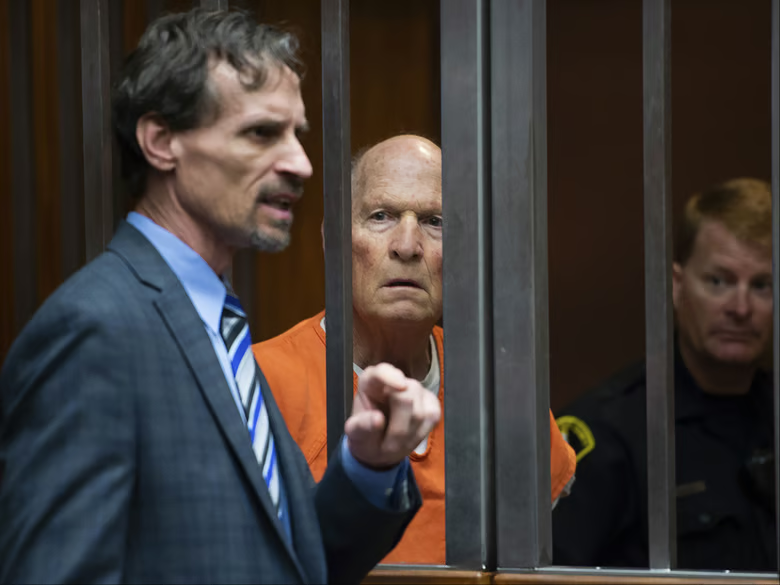
Nobody liked the shape that cast over the table.
That one stretched longer than the others. Visalia Ransacker. Burglaries. Stalking. Then rapes, murders, decades of it, all before the man had a proper name again. The phrase itself, Golden State Killer, sounded too big, too polished, like California had hired Madison Avenue to market its nightmares.
Rusty squinted out at the Dodge.
“Golden State Warrior,” he said.
“What?”
“The car. That’s what it is. Not killer. Warrior. It belonged to the fellows trying to keep all that rot from spreading.”
Rex nodded slowly. “Maybe.”
That was the turn.
Up until then, folks had treated the Dodge as a hearse for old crimes. After that, some began to see it as a witness. Maybe even a patrolman without a pulse. A relic from the side of the law, worn out from carrying too much of what men did to one another.
The theory gained steam because Fort Stockton adored a theory that let everyone feel haunted and righteous at the same time.
Saturday night Angus Hopper, who drifted into town the way dust drifted under a door, claimed he saw the Dodge on the old road south of town with its parking lights on, both spotlights dark, and the silhouette of nobody behind the wheel. He followed it in his truck for half a mile before it took a bend and simply wasn’t there anymore.

“Could’ve gone into a driveway,” Chad said.
“There ain’t a driveway there unless somebody built one for Satan,” Angus replied.
Sunday morning Pastor Peterson preached against idle superstition, but he did so while repeatedly looking through the fellowship hall window at the Dodge sitting under the pecan tree out back, which weakened his position some.
By then, men had crawled under it and reported that the underbody showed plenty of corrosion but no fresh leaks, which made no sense because by all accounts the fuel system needed work, the cooling system needed work, the brakes needed work, and only one parking brake cable functioned. A car in that shape ought not to be wandering around town by itself, even if it had a legal right to be there and a clean title tucked into some faraway filing cabinet.
On Sunday evening, just before dark, Rex said he’d had enough and decided to test the thing.
He got a temporary fuel can, rigged a line, checked that nobody was standing too near, and turned the key while Rusty watched from a safe distance that was not as safe as he claimed later.
The 413 coughed once.
Then again.
Then it caught.
The sound that rolled out of that Dodge was not healthy, but it was authoritative. Deep, uneven, old. It shook dust loose from the firewall and made the torn seat springs quiver. The whole car seemed to wake resentfully, like a retired cop called in on one last shift. Exhaust puffed. Metal vibrated. The sweeping speedometer needle trembled at zero. The push-button gear selector sat ready under Rex’s hand.
He pressed Drive.
Nothing.
Then, slowly, with the low unwilling dignity of a man getting out of church pews after seventy, the Dodge moved forward three feet.
And stopped.
Rex pressed the brake. It held.
He put it in Neutral and shut it off.
The engine ticked and cooled. Everybody around him waited.
“Well?” Rusty asked.
Rex stepped out, looked at the car, then looked toward the sunset washing the square the color of old blood diluted in dishwater.
“It runs,” he said.
“That’s not what I asked.”
Rex took off his glasses and polished them with a handkerchief. “No,” he said. “It isn’t.”
That night the Dodge disappeared again.
Monday morning it was out by the cemetery.
Not in it. Beside it. Parked nose-in toward the iron fence as if waiting for someone late to an appointment.
The whole town came to a quieter stop than usual.

Sister Thelma arrived before anyone else spoke. She stood by the driver’s door and laid one hand against the flaking white paint. Her face did not change, which somehow made everyone more uneasy.
“What is it?” Lucinda asked.
Sister Thelma kept her hand there a moment longer. “I don’t think it’s here to frighten anybody.”
“Then what’s it doing?” Chad asked.
She looked at the cemetery, then back at the Dodge. The wind moved through the grass with a sound like paper turning.
“I believe,” she said, “it is looking for the ones it couldn’t save.”
Nobody had much to say after that.
By late afternoon, the car was gone again.
Toward evening a storm built west of town, clouds stacking purple over the flats. Rusty locked up the hardware store early and crossed the square under a sky that looked ready to confess. The air had that charged, metallic feel it sometimes got before rain, as if every fence post in Pecos County had become part of the same nervous system.
He glanced toward the courthouse and stopped dead.
The Dodge sat at the curb in front of Ben Franklin, angled slightly toward the road, both spotlights facing ahead. No lights on. No engine noise. No driver.
Just sitting.
Waiting.
Rusty stood there alone in the growing dark. For once he had no quip ready. No Christine joke. No California crack. Just that broad old police sedan wearing its rust and scars like citations.
Then, without warning, the red-lensed spotlight on the driver’s side clicked on.
Not bright. Not full. Just a dull red eye in the dusk.
A second later, the clear spotlight on the passenger side came alive too, throwing a pale beam across the empty square toward the courthouse doors.
Rusty did not move.
Inside the car, the AM/FM cassette deck crackled to life by itself.
Static first.

Then a voice, faint and warped by age, too broken to make out as words. Maybe radio, maybe tape, maybe something caught between. It lasted only a few seconds. Long enough to raise the hair on Rusty’s arms. Long enough to sound like somebody trying very hard to get a report through over distance and weather and years.
Then both lights went out.
The radio died.
The storm wind picked up.
And when Rusty finally found the nerve to step off the sidewalk and walk toward it, the square flashed white with lightning.
For one instant the whole town stood in stark daylight.
The courthouse. The flag. The empty curb.
The Dodge was gone.
Only two damp tracks remained in the dust at the edge of the street, leading nowhere anyone could follow before the rain came down and washed Fort Stockton clean of proof.


One response to “GOLDEN STATE WARRIOR”
Only one thing is for sure: The car was most definitely not there to stanch the spread of moral rot and decay.
Because if it were, it would’ve never left the driveway of Mayor Goodman’s house.