
By Jimmy Don Ventura
Movie Critic, Stockton Telegram-Dispatch
Guest Reviewer — CMC Blog
I’ve often said that there are two completely different movies playing on the screen every time you walk into a theater.
The first one is the movie the director intended you to watch.
The second one is the movie car people can’t help but watch.
The average moviegoer watches the actors.
We watch what they’re driving.
The average moviegoer remembers the dialogue.
We remember the dashboard.
The average moviegoer notices who gets kissed.
We notice whether the windshield wipers are parked correctly.
Neither group is wrong.
We’re just wired differently.
That became painfully obvious one morning last week at the GFD when I walked in carrying my old VHS copy of Top Gun under one arm and a yellow legal pad under the other. Lucinda pointed toward the booth where the regulars were already gathered and asked whether I was planning to teach a class. I told her I sort of was. Every month I seem to discover another movie where the automobiles are quietly doing as much storytelling as the actors, and every month Chad reminds me that I’m probably the only human being on Earth who notices such things.
Sure enough, before I had even finished pouring cream into my coffee, Chad looked at the tape lying beside my plate and frowned.
“Top Gun?“
“That’s the one.”
“I thought you reviewed movies with cars.”
“I do.”
“It’s got airplanes.”
“It does.”
“So…where are the cars?”
Before I could answer, Angus Hopper folded his newspaper, looked over the top of his glasses and smiled the way he always does when somebody has unknowingly stepped into one of Jimmy Don’s favorite rabbit holes.
“If it’s got wheels,” Angus said, “Jimmy Don’ll find ’em.”
Hairless B-29 took a sip of coffee and nodded in agreement.
“Airplanes are just automobiles that got too big for their britches.”
Rex Hall never even looked up from buttering his toast.
“Actually,” he said, “they’re automobiles with significantly more expensive insurance.”
That’s about the time Mayor Goodman wandered in, heard the last sentence, and announced to nobody in particular that he’d seen Top Gun twice.
Knowing the Mayor as well as we all do, that statement carried about the same level of comfort as hearing your dentist say, “Now this is interesting.”
“What’d you think?” I asked.
He smiled.
“I learned something both times.”
There wasn’t a person at the table who wasn’t suddenly worried.
Fortunately, we’ll come back to the Mayor in a little while.
Right now, let’s talk about one of the most influential movies of the 1980s.
Released on May 16, 1986, Top Gun made Tom Cruise an international superstar practically overnight. At just twenty-three years old, Cruise already had several successful films under his belt, but this was the one that permanently attached his name to movie stardom. Directed by Tony Scott and inspired by Ehud Yonay’s 1983 magazine article about the Navy Fighter Weapons School at Miramar, Top Gun became far more than another action picture. It earned over $357 million worldwide, won an Academy Award for Berlin’s “Take My Breath Away,” launched one of the best-selling soundtracks of the decade, increased Navy recruiting, sent Ray-Ban Aviator sales soaring by forty percent, and somehow convinced millions of young men that if they bought a leather flight jacket, women would immediately begin appearing in slow motion.
History has proven otherwise.
The movie itself still holds up remarkably well because Tony Scott insisted on filming real airplanes doing real airplane things. There are no computer-generated dogfights because, in 1986, there really weren’t any computers capable of doing what Scott wanted. The Navy cooperated extensively, allowing production at NAS Miramar and aboard the USS Enterprise, while some of the aerial photography was flown by pilots who would later become legends in their own right. Future astronaut Scott Altman flew several of the sequences before eventually deciding Earth wasn’t nearly high enough.
Tragically, renowned aerial cameraman Art Scholl lost his life during production when his camera aircraft entered a flat spin over the Pacific Ocean and never recovered. His body and aircraft were never found, and the completed film is dedicated to his memory. It’s a sobering reminder that even making movies about dangerous professions sometimes becomes dangerous work itself.
The authenticity extended beyond the airplanes. Kelly McGillis’ character, Charlie, was based on real-life civilian defense analyst Christine Fox, while Tom Skerritt’s “Viper” drew inspiration from legendary Navy pilot Pete Pettigrew, who also served as a technical advisor and even appears briefly in the film. Those little touches matter. Good movies are often built from dozens of tiny pieces of reality that most audiences never consciously notice.
Which brings us to automobiles.
You knew we’d get there eventually.
Most people remember Maverick’s motorcycle before they remember any four-wheeled vehicle in the picture, and with good reason. The Kawasaki GPZ900R Ninja may have become the most famous motorcycle in movie history not named “Captain America.” Introduced only a couple of years earlier, the GPZ900R was astonishingly advanced for its day, capable of nearly 155 miles per hour and powered by a liquid-cooled 908 cc inline four-cylinder engine that rewrote the performance standards of the mid-1980s.
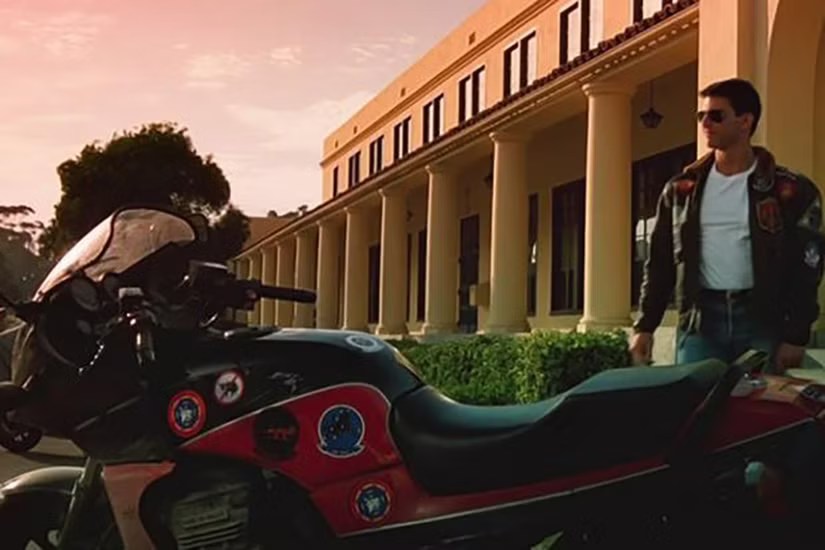

It also looked spectacular.
I don’t know if it’s physically possible to make a motorcycle look fast while it’s parked, but Kawasaki somehow managed it.
Now, before anybody writes me a letter, yes, I know Maverick wasn’t actually racing an F-14 Tomcat down the runway. The Tomcat was taxiing for takeoff, which is rather like claiming you outran your neighbor because he was backing his pickup out of the garage. Nevertheless, Tony Scott understood something that every great automotive filmmaker eventually figures out.
Reality is important.
Looking cool is important, too.
Sometimes those two things don’t occupy exactly the same zip code.
The motorcycle wasn’t simply transportation. It became part of Maverick’s personality. Independent. Fast. Loud. Slightly reckless. It told you almost everything you needed to know about him before he ever climbed into a cockpit.
That’s good filmmaking.
The same thing happens with Charlie’s little black convertible, although most viewers don’t realize exactly what they’re looking at.
I’ve lost count of how many times I’ve heard someone confidently identify Charlie’s car as an early Porsche 911. Every now and then somebody calls it a Volkswagen Beetle that somebody shrunk in the dryer. If you say either of those things within earshot of a Porsche owners’ club, don’t be surprised if somebody quietly removes your membership application before you’ve finished speaking.
Charlie’s car is presented as a Porsche 356A Speedster, one of the most historically significant sports cars Porsche ever built. Long before the 911 became the company’s signature automobile, the 356 established Porsche’s reputation for lightweight engineering, precise handling, and understated elegance. Genuine Speedsters today command prices that would cause the average mortgage lender to reach for smelling salts.
Hollywood wasn’t about to risk one.
Instead, the production used an exceptionally well-built replica manufactured by Intermeccanica, a Canadian company whose recreations have long been respected by enthusiasts. Unless someone tells you the truth beforehand, you’ll probably never know the difference. The proportions are right. The stance is right. The details are right. It performs exactly the job the filmmakers needed it to perform without placing an irreplaceable collector car in unnecessary danger.
That’s smart filmmaking.


It’s also one of those behind-the-scenes decisions that reminds you there were genuine car people involved in making this picture. They could have substituted any generic little convertible and ninety-five percent of the audience would never have questioned it.
They didn’t.
They chose a Speedster.
That tells me somebody cared.
Then we arrive at what may be the greatest example of automotive casting in the entire film.
The volleyball scene.
Now, I’m fully aware that this sequence has achieved near-mythical status over the past forty years. It launched a thousand magazine covers, inspired countless parodies, and reportedly consumed an entire day of Tony Scott’s shooting schedule despite occupying only a few minutes of screen time. Studio executives were less than thrilled with the amount of time being spent filming shirtless volleyball, although history has clearly sided with Scott.
Most viewers remember the game.
Car people remember the parking lot.
Watch that scene again, but this time ignore Maverick, Goose, Iceman, and everybody diving around in the sand.
Look behind them.
What you see isn’t random.
It’s a carefully assembled snapshot of Southern California car culture in the mid-1980s.

Parked around the edges of the volleyball court sits a first-generation Mazda RX-7, still one of the prettiest rotary-powered sports cars ever built. Nearby rests a first-generation Ford Mustang that quietly reminds you America had been building sporty coupes long before anybody coined the phrase “pony car.” A pair of Pontiac Firebirds makes appearances from different angles, joined by a third-generation Chevrolet Camaro wearing removable T-tops because, in 1986, California law practically required at least one T-top Camaro to be visible in every county.
There’s a Mercedes-Benz SL adding just enough European sophistication to the lineup, while a first-generation Corvette contributes a little American sports car history to the background.
Most directors would have stopped there.
Tony Scott didn’t.
Quietly sitting off to one side through the entire sequence is one of my favorite automobiles in the whole movie.
A weathered 1955 Chevrolet 210.
Not polished into trailer-queen perfection.
Not restored until every bolt looked like jewelry.
Just an honest old Chevrolet that looked exactly like the sort of car a young Navy sailor might proudly own.
As it turns out…
…that’s exactly what it was.
That wonderfully authentic 1955 Chevrolet 210 wasn’t supplied by the studio at all. It belonged to an actual United States Navy sailor stationed at Top Gun. Director Tony Scott happened to see a photograph of the car sitting on the sailor’s desk, liked its honest, unpretentious appearance, and asked if it could be used in the film. That’s one of my favorite stories in all of moviemaking because it tells you something about Tony Scott that doesn’t show up in the credits.
He noticed the background.
A lot of directors don’t.
To them, the automobiles parked behind the actors are simply transportation. Fill the space. Keep the parking lot from looking empty. Nobody’s paying attention anyway.
Scott understood that people notice more than they realize.
Every frame tells a story.
Every parked car belongs to somebody.
That old Chevrolet wasn’t just transportation. It told us somebody serving his country drove it to work every morning, parked it beside the volleyball court, and probably spent Saturday afternoons washing it while listening to the Padres game on the radio. It added authenticity without ever calling attention to itself. If you never noticed it, the movie still worked beautifully. If you did notice it, the movie rewarded you for paying attention.
That’s craftsmanship.
Even better, the Chevrolet still exists today. A group of enthusiasts documented its complete restoration over several YouTube episodes, preserving not only the automobile but a tiny piece of movie history that could have easily disappeared. Car people understand something the rest of the world occasionally forgets.
Automobiles don’t simply survive.
Stories survive with them.
That’s why I can spend an hour talking about an old Chevrolet that probably occupies less than thirty seconds of screen time.
The rabbit hole gets even deeper once Charlie begins chasing Maverick through downtown San Diego. Now, before anybody writes to correct me, yes, I realize there isn’t a chance on God’s green Earth that a Porsche 356 Speedster, replica or otherwise, is going to keep pace with a Kawasaki GPZ900R weaving through traffic. If the laws of physics had been invited to that sequence, they politely declined.
Fortunately, movies aren’t documentaries.
They’re dreams with better lighting.

What fascinates me isn’t the chase itself. It’s what Tony Scott sprinkled around the edges. As Charlie barrels through intersections, the background becomes another rolling automotive time capsule. Waiting patiently at one light are a Fox-body Ford Mustang convertible, a Pontiac Trans Am, a Datsun 240Z, and a Porsche 911. Later in the picture, after Goose’s heartbreaking death, another Datsun quietly appears in the background, this time a 280ZX.
Now, is it realistic to believe every third person in greater San Diego drove a sports car in 1986?
Probably not.
Then again, I once attended a cruise night in Odessa where it briefly appeared every resident owned either a Tri-Five Chevrolet or a ’69 Camaro, so perhaps Southern California deserves a little benefit of the doubt.
Either way, it makes the world feel more interesting.
The military vehicles deserve a tip of the cap as well. The Chevrolet K-5 Blazers, Navy pickups, support trucks, fuel rigs, and maintenance equipment scattered throughout Miramar don’t receive glamorous close-ups. They simply go about their jobs in the background, exactly as they would on any busy military installation. Those vehicles are the bass players in the orchestra. Nobody leaves the theater talking about them, but remove them from the picture and suddenly everything feels artificial.
That’s another lesson good filmmakers understand.
Authenticity is usually built from details nobody notices consciously.
Which brings me back to Mayor Goodman.
I promised we’d return to him.
I should have known better.
Once breakfast was nearly over and I’d finished explaining why the volleyball parking lot deserved its own Academy Award, the Mayor leaned back in the booth, folded his hands across his stomach, and announced that Top Gun had taught him a valuable life lesson.
Whenever Mayor Goodman says a movie taught him something, I instinctively check to make sure my wallet is still in my pocket.
“What’d you learn?” I asked.
He looked around the table like a professor preparing to reveal the meaning of life.
“If I’d been a young man back then,” he said, “I’d have found me one of them doctors that’d certify I had bone spurs.”
The entire booth went silent.
Even Delgado stopped scraping the grill.
“So I wouldn’t have to fool with all that military business.”
I stared at him for several seconds, hoping there was more coming.
There wasn’t.
“Mayor,” I finally said, “you watched one of the finest aviation movies ever made…”
“I did.”
“…a movie about courage, sacrifice, teamwork, discipline, and service…”
“That’s right.”
“…and your takeaway was to avoid all of it?”
He shrugged.
“Those airplanes looked dangerous.”
“They were.”
“So I figured it’d be better to stay home.”
Hairless looked over the rim of his coffee cup.
“You’re scared of elevators.”
“I am not.”
“You made your grandson carry groceries down four flights of stairs because you didn’t trust the cables.”
“It was good exercise.”
Lucinda happened to arrive with the coffee pot at exactly the right moment.
“The only spurs you’ve ever had,” she said without breaking stride, “were on cowboy boots.”
Everybody laughed except the Mayor.
He still wasn’t finished.
He leaned toward me and lowered his voice like he was about to share classified government information.
“The chicks you get aren’t equal to the ones Tom Cruise scored…”
He paused just long enough to admire his own setup.
“…but they don’t cost nearly as much either.”
Another pause.
“Even when you factor in the cost of penicillin.”
Delgado stuck his head through the order window.
“Mayor…”
“Yes?”
“That may be the dumbest sentence ever spoken in this diner.”
Mayor Goodman smiled.
“I’ve still got two days left in the week.”
The sad part is nobody at the table could honestly argue with him.
Now, before somebody accuses me of making light of military service, let me say something that Top Gun understood from its opening scene.
This movie works because, underneath all the swagger, sunglasses, motorcycles, and Kenny Loggins songs, it’s ultimately about young men and women carrying responsibilities most of us will never experience. Maverick isn’t simply learning how to fly faster than everyone else. He’s learning humility. He’s learning accountability. He’s learning that talent alone isn’t enough.
That’s why the movie has endured.
The flying is spectacular.
The soundtrack is unforgettable.
The photography remains gorgeous.
But the heart of the picture is still human.
And, strangely enough, I think that’s where the automobiles fit into the story.
Tony Scott didn’t populate his backgrounds with anonymous beige sedans because anonymous beige sedans don’t tell us much about the people inhabiting that world. Instead, he filled those frames with Mustangs, RX-7s, Firebirds, Camaros, Corvettes, Datsuns, Mercedes roadsters, Navy Blazers, and one wonderfully ordinary ’55 Chevrolet owned by a real sailor.

He cast the automobiles the same way he cast the actors.
Each one belonged there.
Each one helped define the world.
Each one quietly whispered something about the people who drove them.
That’s something I wish more filmmakers understood today.
Too many modern movies treat automobiles as disposable appliances. They crash them because computers can build another one before lunch. They fill parking lots with anonymous crossovers because nobody involved stopped to ask what kind of person might actually own that car.
Top Gun never makes that mistake.
Its machinery matters.
Whether it’s an F-14 Tomcat, a Kawasaki Ninja, a Porsche Speedster, or a weathered old Chevrolet parked beside a volleyball court, every machine has personality.
Every machine has purpose.
And every machine belongs to somebody.
Maybe that’s why the movie still feels alive after four decades.
As I gathered my notes to leave, Lucinda topped off my coffee one last time and asked whether I’d finally finished talking about Top Gun.
“I think so.”
Hairless grinned.
“So what’s next month’s movie?”
“I haven’t decided yet.”
“What if there ain’t any cars in it?”
I slid my legal pad under one arm and smiled.
“Then I’ll review the parking lot.”
Angus laughed.
Rex shook his head knowingly.
Lucinda smiled as she carried another pot of coffee toward the front counter.
And Mayor Goodman, who had somehow managed to miss the entire point of Top Gun while simultaneously remembering every scene with Kelly McGillis, announced that if Hollywood ever made a movie about bone spurs, he’d be first in line.
Some people leave a theater remembering the airplanes.
Some remember the romance.
Some remember the music.
Me?
I’ll remember the fellow who drove his honest old 1955 Chevrolet to work every morning, parked it beside a volleyball court at Miramar, and unknowingly gave generations of car people one more reason to watch Top Gun again.
★★★★½ out of five chrome wheel covers.
Now, if you’ll excuse me, I’ve got a sudden urge to go home, put on a pair of aviator sunglasses, cue up Kenny Loggins, and drive absolutely nowhere in particular.
Just don’t expect me to race any fighter jets getting there.


2 responses to “MOVIE REVIEW: TOP GUN”
John Wayne plays John Wayne – no one else can do it better.
Tom Cruise plays Tom Cruise – no one else can do it better.
This is an excellent review – it makes me want to be a better movie watcher!
My first movie memory is back in the 1940’s, – I was 5 or 6 years old – our family had just watched a Tarzan movie in downtown Houston, which was a very big treat for us money-wise. As we exited the movie and I was holding Mom’s hand, I decided to act like Cheeta – walked like him, “ooog-ooog” like him. I made my family happy.
So, that’s what movies make us do!
Ok, Cappy! The Ninja was not the only Kawasaki in the film. Seen in the background of the P-51 scene near the end of the movie is a ‘72 H-2 750 Triple…the Widowmaker! Maybe that belonged to Goose?