
The word stripper does not mean what it used to mean.
I came to this conclusion while reading about the 2027 Ford Maverick XL, which is described as the stripped-down version of Ford’s small pickup. The least expensive Maverick now starts at $29,990, including destination charges, and comes only with a hybrid powertrain producing 191 horsepower. It has an automatic transmission, front-wheel drive, four full-sized doors, seating for five, air conditioning, power steering, power brakes, power windows, power door locks, remote keyless entry, cruise control, LED headlights, automatic high beams, a rearview camera and enough electronic safety equipment to keep the driver from changing lanes, running into something or making certain other decisions Ford believes he cannot be trusted to make alone.
It also has a 13.2-inch touchscreen, six speakers, Bluetooth, wireless Apple CarPlay, wireless Android Auto and its own Wi-Fi hotspot.
This is considered the stripper.
Apparently, we have reached the point where even poverty requires internet access.

My 1960 Ford Fairlane 500 was also something close to a stripper, although technically it represented the second rung on Ford’s three-rung ladder of full-sized automobiles. At the bottom was the Fairlane. Mid-range sat sat the Fairlane 500. At the top was the Galaxie, intended for people who had inherited money, discovered oil or recently become convinced that heaven had a chrome accessories department.
The ordinary Fairlane was Ford’s admission that not everybody in America had enjoyed a particularly good year. It was a large automobile with an engine, four wheels and enough bodywork to keep rain from striking the occupants directly. It carried almost no exterior identification beyond the word FORD, apparently because the company did not wish to embarrass the owner by making his financial condition legible from across the street.

There was no Fairlane script anywhere on it. If you drove one home from Frontier Ford, “Home of the Straight Shootin’ Deal”, the neighbors could stand in your driveway for twenty minutes and still not know what you had bought. Eventually you would have to tell them.
“It’s a Fairlane,” you would say.
They would nod slowly and look at their shoes.
“Well,” one of them might answer. “It sure is blue.”
That was roughly the extent of the ceremony.
Ford undoubtedly sold some base Fairlanes to ordinary retail customers, but I suspect the company chiefly had police departments, highway patrol agencies and taxi companies in mind. Those organizations required vehicles capable of running all day, absorbing abuse and being hosed out occasionally. The private buyer who selected one was making a statement, although perhaps not the statement he intended. He was announcing that vanity had never interfered with his life and probably never would. Andy Griffith drove one in Mayberry the first season he assumed duties as sheriff, making his the most recognizable one ever built. It was black and white. (The show and the Ford.)

For the man whose dreams had survived the down payment, there was the Fairlane 500.
The Fairlane 500 was mechanically much the same automobile, but Ford dressed it up enough that the neighbors would not begin collecting canned goods when they saw it beneath the carport. Chrome script on the front fenders spelled out Fairlane 500 in what looked like your lesbian aunt’s handwriting. Across the trunk lid, individual block letters announced F-A-I-R-L-A-N-E, with the trunk lock concealed behind the “R” like a communist hiding in the State Department.
A red, white and blue Ford crest stood proudly on the hood, showing off like a teenage boy who had just copped his first feel. Five chrome spears decorated each rear fender. Bright trim surrounded the windshield and rear window. None of this made the car start faster, stop shorter or steer more easily, but it told the neighbors that you had considered the base model and rejected it on moral grounds.
Inside, the Fairlane 500 came with nicer woven nylon and Morocco-grain vinyl upholstery, improved door panels and armrests on every door.
Armrests.
All four of them.
Today an armrest is something you discover only after spilling a thirty-two-ounce Big Gulp into the cupholder beside it. In 1960, an armrest was evidence of upward mobility. It meant your family had reached a point at which no elbow was expected to support itself. A man could drive home from Frontier Ford, rest his left arm against the door and know that every difficult decision he had made since leaving high school had been vindicated.
The base Fairlane had rubber flooring available in three interior colors, provided all three colors were black. The Fairlane 500 also had rubber flooring, but it was color-coordinated to match one of four available interiors. That was luxury in 1960: the mud beneath your feet harmonized with the upholstery.
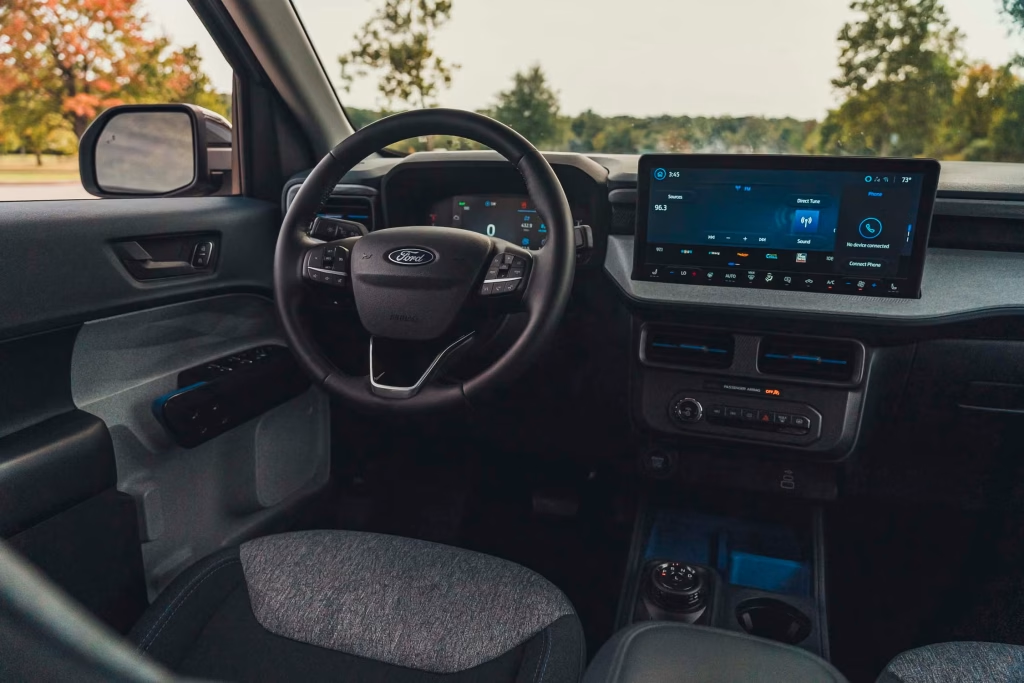
The 2027 Maverick XL has cloth seats, carpeting and under-seat storage in the rear. The steering wheel tilts and telescopes. The front seats provide adjustable lumbar support. The cabin has numerous bins, pockets and molded places for phones, drinks, charging cables and the other supplies required to survive the six-minute drive from Walmart to the house. Should Walmart somehow not have what you drove your Maverick there to purchase, you can easily go back home, get out of your pajamas, shower, and go to Target. Two more options not yet dreamed of in 1960.
Its air conditioner is standard.
My Fairlane has a heater.
That distinction neatly summarizes sixty-seven years of American progress. The Maverick keeps its occupants cool in August. The Fairlane allows its occupants to choose among being hot, being extremely hot and opening the vent windows to admit air heated naturally over the surface area of Pecos County.
The Fairlane does have triangular vent windows in the front doors, which represent a sort of manually operated climate-control system. You turn a little latch and aim the glass toward your face. At forty-five miles per hour, this creates a concentrated stream of air, dust, grasshopper fragments and whatever smell is currently being manufactured by the feedlot west of town.
No subscription is required.

The 2027 Maverick’s standard hybrid system combines a 2.5-liter four-cylinder engine with an electric motor and sends 191 horsepower through a continuously variable automatic transmission. The truck can return approximately 39 miles per gallon combined and as much as 42 in city driving. You press the accelerator and computers conduct a private meeting about which form of propulsion should move you forward. Electricity may handle part of the task. Gasoline may handle the rest. The driver is not consulted because his role in the process is largely ceremonial.

My 1960 Ford has a 223-cubic-inch Mileage Maker Six producing 145 horsepower, connected to a two-speed Ford-O-Matic transmission shifted from the steering column. The rear axle ratio is 3.89 to one. When I want the car to move, I depress the brake pedal, select “D” and then press the accelerator with sufficient delicacy to prevent the engine from dying in front of witnesses. Of course, I would have pulled out the “choke”button on the dashboard as sort of a mutual handshake with the car before starting that procedure.
There is no computer meeting.
There is only me, the choke and the possibility of public humiliation.
The Maverick has power-assisted disc brakes and anti-lock braking. My Fairlane has non-power drum brakes, which means stopping is less an event than a proposal submitted several seconds in advance. The Maverick has electric power steering. The Fairlane has a large steering wheel and the assumption that anyone wealthy enough to own a car eats enough red meat to turn it.
Neither power steering nor power brakes came standard on the Fairlane 500. Neither did an outside rearview mirror. Neither did a radio. Neither did backup lights.
Think about that last one. In 1960 you could purchase an entirely new full-sized automobile and reverse it into the darkness without alerting anybody behind you. Ford apparently believed that anyone standing there would recognize the sound of an approaching bumper and take personal responsibility for his future.
The Maverick, by comparison, has a rearview camera. Shift into reverse and the touchscreen displays the area behind the truck, complete with guidelines to assist the driver. If something crosses the camera’s field of vision, the vehicle may issue a warning. Some versions can monitor traffic approaching from the sides.
The Fairlane offered a rear window.
The driver turned around and looked through it.
This was before the human neck became optional equipment.
The 2027 Maverick also provides automatic emergency braking, lane-departure warning and lane-keeping assistance. If the truck decides you are drifting across a painted line, it can alert you and help guide you back. The Fairlane has no opinion concerning lane position. It assumes the driver has somewhere in mind and is doing his best to get there.
If I drift toward the centerline, the Fairlane does not vibrate the steering wheel, display a warning or correct my course. It allows the oncoming Buick to handle customer notification.
The Maverick’s six-speaker sound system can play music streamed wirelessly from a telephone. Mine left the factory without a radio. The center of the dashboard contains a metal plate where the radio would have gone if the original purchaser had possessed both money and weak enough character to spend it frivolously.
There is something wonderfully honest about a radio-delete plate. It does not pretend to be storage. It does not contain a tasteful emblem or motivational phrase. It simply covers the hole where entertainment would have been.
You want music?
Hum.
You want news?
Wait until you get somewhere.
You want directions?
Stop at a service station and ask a man whose explanation will begin with a building that burned down in 1948.
The modern Maverick has wireless Apple CarPlay and Android Auto, allowing the touchscreen to display maps, messages, music, weather and telephone functions. It has voice recognition, which means the driver can ask the truck for directions without removing his hands from the wheel.
In the Fairlane, voice recognition meant Buttercup recognizing my voice after I admitted we were lost.
The base Maverick has remote keyless entry. Press a button and the doors unlock from several yards away. The Fairlane uses a metal key. You insert it into the door, turn it and open the car manually, a process modern society now regards as scarcely more civilized than butchering livestock in the parking lot.
That same key starts the engine. There is no immobilizer chip, proximity sensor or push-button ignition. The Fairlane does not need to determine whether the authorized driver is inside. It assumes that anyone who has successfully entered the vehicle knows somebody.
The Maverick has standard power windows. The Fairlane uses window cranks. Rolling down all four windows requires either walking around the automobile before departure or recruiting passengers. Children once served an important mechanical function in the family automobile.
“Roll down your window.”
“How far?”
“All the way.”
“Why?”
“Because it’s 104 degrees and the upholstery is preparing to brand us.”
The Fairlane 500 did, however, include a dome light that came on automatically when a door opened. This was a serious feature. The base Fairlane apparently left its occupants to enter and exit under cover of darkness, but the 500 illuminated them. Perhaps Ford intended the light to reveal the owner’s satisfied expression as he lowered himself onto the color-coordinated rubber mat.
It also came with a lighted instrument cluster, a glove-compartment lamp and a lighted ashtray. The automobile may not have helped you steer or stop, but Ford made certain you could find your cigarette at night.
There was an ashtray in the back seat, too. Nothing said you had arrived like providing smoking accommodations for passengers who did not have to help drive. Today, automakers hide multiple USB ports throughout a cabin so children will not endure the unspeakable hardship of a discharged tablet. In 1960, Ford gave them a place to knock the ash off a Chesterfield.
Every generation protects its young according to its values.
Kandy Kane over at the Scuttlebutt Gentleman’s Club understands the changing meaning of stripper better than anybody. Kandy has power-adjustable stage lighting, wireless music, climate control and—according to a sign beside the bar—an ATM with a service fee substantial enough to qualify as predatory lending.
She works in considerably greater comfort than a 1960 Fairlane driver.
Kandy also has more safety equipment. There is a security camera above the entrance, an illuminated exit sign near the stage and Hairless B29 sitting by the door on Friday nights. My Fairlane has lap belts only because I added them later. In 1960, Ford’s primary occupant-restraint strategy consisted of a steering wheel large enough for the driver to embrace during impact.

And yet the Fairlane 500 was not considered austere. It was the upgrade. People willingly paid more for four chrome spears on each rear fender, color-keyed rubber mats and armrests. Ford sold 244,275 Fairlane 500s in 1960, compared with 205,667 examples of the plain Fairlane. Another 289,268 buyers climbed all the way to the Galaxie, proving there were already plenty of Americans whose billfolds knew no bounds.
But most Fairlane 500 buyers probably felt they had chosen sensibly. They had not purchased the cheapest Ford. Neither had they surrendered to the shameless excess of the Galaxie. They stood in the exact center of American respectability, elbows supported and ashtrays illuminated.

The 2027 Maverick XL occupies the bottom of its lineup, yet it would have appeared almost supernatural in 1960. It starts itself with electricity. It stops itself to avoid collisions. It watches the lanes, illuminates the road automatically, carries five people behind airbags, communicates with satellites and connects wirelessly to a worldwide information network.
It can also haul 1,500 pounds and tow 2,000 pounds in standard form.
Car and Driver describes the base Maverick as “too basic.”
Poor thing.
No heated steering wheel.
No ambient interior lighting.
No Bang & Olufsen sound system.
It must be difficult arriving at the Scuttlebutt under those conditions.
I do not object to comfort. I enjoy air conditioning and power steering as much as the next spoiled American. I have no principled opposition to anti-lock brakes, rearview cameras or a truck that helps prevent me from running over a shopping cart at Piggly Wiggly. Progress has its benefits, particularly when it keeps Sheriff Vickers from having to fill out paperwork.
But our definition of deprivation has drifted.
The automobile industry can place a hybrid powertrain, automatic transmission, touchscreen, six speakers, Wi-Fi hotspot, power accessories, cruise control and electronic guardian angels into a vehicle and still call it stripped down because the wheels are steel and the seats must be adjusted by hand.
In 1960, an outside mirror was extra.
Maybe that is what has gone wrong in America. We no longer recognize plenty because we have been trained to concentrate on whatever is missing. A new vehicle can contain more technology than NASA possessed during the Mercury program, but if it does not warm our backside or remember the position of our seat, we study the window sticker with the wounded expression of people being asked to churn butter.
We have raised our expectations for strippers beyond the point of reason.
Kandy Kane can probably confirm this. There was surely a time when a stripper needed only music, a stage and sufficient confidence to make questionable career choices seem empowering. Now the customers expect theatrical lighting, signature cocktails, an online schedule and free Wi-Fi. Somebody at the Scuttlebutt has probably suggested an app.
Kandy would reject it.
She has standards.
The Fairlane reminds me of a time when improvement arrived in small, visible increments. The base model had black rubber flooring. The 500 had color-coordinated rubber flooring. The base model left your elbow to fend for itself. The 500 provided an armrest. The plain Fairlane had an anonymous flank. The 500 wore chrome script and eight rear-fender spears that pointed directly toward improved self-esteem.
Those things were not necessities. That was why they mattered. They allowed an ordinary family to feel that it had moved one careful step beyond merely getting by.
You could stand beneath the carport in Fort Stockton, run your hand across that chrome Fairlane 500 script and know you had made it. Not all the way, perhaps. The Galaxie remained farther up the ladder, glittering shamelessly in some richer man’s driveway. But you had advanced far enough that the neighbors would not feel sorry for you.
And after dark, when you opened the door, the dome light came on so they could see that you knew it.
Someone walking into Frontier Ford looking for a stripped Maverick doesn’t appreciate how much things have changed. He takes the armrest for granted. He feels entitled to backup lights. He regards a navigation system, even a rudimentary one, as some kind of God-given right. And perhaps the greatest indignity that poor soul must suffer with a stripper Maverick is that Ford does not offer a pair of fender skirts to dress it up.
Kandy Kane enjoys a good fender skirt.


11 responses to “STRIPPERS”
“Kandy Kane enjoys a good fender skirt.”
It looks to me like Kandy is wearing her skirt around her trunk. And, there is money stuffed in it. That gives me an idea about further bedazzling your Fairlane 500…
For perspective: imagine yourself 100 years into the future…or 500 years.
What will yourself look back at in 2026 and laugh!
My personal joke is that maybe we will all “be” either a physical brain on a shelf (or whatever they call a shelf then), or just a chip (whatever that is/will be), or maybe a rift in a cloud!
BUT, whatever it is – will be “normal.” So there!!! (Why am I sitting here, making my fingers move – it’s called typing on the keyboard – note to my self in 2126 AD.)
I always thought heated steering wheels were stupid – until I got one! Feels good here during the Northern Ohio winters.
That’s how luxuries become necessities. (I can’t live without my 360 degree view camera. But I didn’t know they existed before I bought the car.)
I think the biggest difference between 1960 and 2027 automobiles is that, in 1960, the automakers thought that people driving cars were responsible enough to pay attention to the task at hand. By 2027, the automakers had learned better.
Lease it, don’t buy it. Once it’s out of warranty, you won’t like paying to fix it.
On the other hand…few things are better than owning something outright, free of debt, and not having any payments. But that’s just me.
I’ve seen shoppers walk out of a showroom if the vehicle they’re considering doesn’t have a heated steering wheel, and this is in So. Texas where one would maybe be inclined to use that feature once or twice a year-if even that.
Although not as eloquently put or expansive, relative to the Captain’s essay, but definitely more profane, George Carlin expressed the same sentiment years back when he railed against the “p*ssification” of America. What would he think in 2026?
Now I’m going to hit my key fob to remotely turn on my truck so the cab will be nice and cool before I hop in it. And I hope I remembered to leave on the air conditioned seats.
I’ve never quite figured out the reasoning behind building cars which shut themselves down when idling more than 15 seconds at a stoplight, but which have a remote start feature so the driver can let the car idle for 15 minutes to “warm up” before heading out on the 5 minute trip to the Eggs and Ammo for beer and cigs.
Nobody likes to be cold on a beer run to the Eggs And Ammo.
B-Double E-Double R-U-N…beer run!